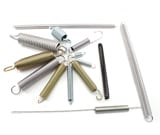
 All springs are constructed to have an initial tension, that force that keeps the coils together in a set position. As a measurement, initial tension is the load or force necessary to overcome the internal force to start coil separation. How to calculate spring tension, and its importance will help to determine how effectively a spring will function in a particular application. Measuring how much potential energy is stored in the spring and the force required to deform it must be calculated.
Springs are remarkable devices, and they are one the oldest and simplest applications used for storing and supplying mechanical energy. When a spring is deformed, i.e., stretched or pulled, from its free state, the stored energy in the spring, its elastic potential energy (PE), is released. Once that potential energy is released, a spring is designed to return to its original shape after being compressed, stretched or twisted.
Application of Springs
Springs absorb or release energy to create resistance to pulling or pushing force. We know, according to Hooke’s Law, when a spring is stretched or compressed the necessary force to do so will vary in a linear way, proportional to its displacement. Hooke observed that the force to compress or extend a spring a specified distance is proportional to that distance. To determine the amount of potential energy the spring has or can supply must be calculated.
The work required in compressing or stretching a spring must go into the energy stored in the spring. As mentioned, the energy stored in a spring when you compress or stretch it is referred to as its PE (elastic potential energy). PE is equal to the force, F, times the distance, s, which is referred to as spring force. Because the force exerted by the spring is always in the opposite direction to its displacement, Fs is referred to as a restoring force.
Hooke’s Law
Therefore, expressed by Hooke’s law, i.e., the Fs required to change the length of a spring is directly proportional to the spring constant (k) and the displacement of the spring and, as expressed as a formula in two equations, reads:
Fs = kx
PEs = 1/2 k * x^2
Fs = spring force
k = spring constant (the spring constant (k) is defined as the ratio of the force affecting the spring to the displacement caused by it).
x = change in spring length from starting position
PEs = Potential energy of the spring. (J)
Custom Spring Manufacturing
James Spring & Wire Company is a custom manufacturer of springs. We offer a wide assortment of all types of springs that meet the application needs across a broad range of industrial sectors. Utilizing contemporary wire and spring manufacturing technology combined with the most advanced equipment, we strive to exceed our customers’ expectations. We offer standard size and custom-designed compression springs, extension springs, and torsion springs.
If you wish to discuss how to measure the initial tension of a spring or the calculation necessary for your application, contact us today! We provide our customers with a complete understanding of our products and the material requirements for even the toughest spring or wire form challenges.