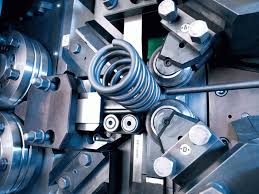
Custom spring manufacturing is designed for customized or unique spring applications for products. Determining how springs are made relates to the application. Custom springs are made to meet specific design requirements for products across multiple industrial sectors—aerospace, automotive, medical, IT and AI, trades and construction, agriculture, manufacturing, and so on. They can vary greatly with each application.
Design and manufacturing of custom spring components may provide necessary bends or legs, or a specific dual pitch or diameter, in order for a product to function properly. Custom springs also ensure that material property requirements meet the application needs of the product. Such material properties are often unavailable in standard stock springs that are manufactured to fit standard sizes, with designs intended for general purpose applications. Stock springs do not account for such variables as necessary stress or torque or environmental factors that will influence spring performance. It is for such reasons that custom spring manufacturing plays a vital role in providing industrial sectors with the custom part for custom applications.
How custom springs are made will be determined by the application requirements of the spring. Springs are exceptionally useful mechanical devices and one of the most widely used components in manufacturing products. Springs store potential energy due to their elasticity. That elasticity is the material property of springs which allows them to return to their original shape and size after a force, whether through compression, extension, or torsion, has caused a deformation of the material as the energy is released. Elasticity ensures that springs return to their initial size or position whenever a force is applied. If a spring cannot return to its initial position then it is considered permanently deformed and needs to be replaced for the application to function as designed.
Spring Material
In general, springs are most often made of hardened steel either pre-hardened before the formation of the spring or hardened after formation. Non-ferrous metals like bronze or titanium are also used in spring applications. The different materials used in the custom manufacturing of springs all relate its intended use.
Any type of spring—compression, extension or torsion—is formed into a helical shape from bar stock or wire that’s been fed through an auto-coiler machine. As the name suggests, an auto-coiler shapes spring wire into a desired coiled form. Rollers are used to evenly feed the spring wire through headers that rapidly spins it around a cylinder. The spinning action permanently transforms the wire into a coiled helical shape. Once the shape has been achieved, the spring is ejected from the machine and the process begins again.
Preprogrammed adjustable auto-coil machines produce custom spring manufactured components—specific coil tension, length, and other custom features as required to customize the spring’s geometry. Such design factors as the wire diameter of the spring material or the coil diameter to measure how tight the spring will be, its free length when set, and the number of active coils which expand and contract (or vice versa) that are required for the application under normal use can be achieved when customizing the geometry.
Unlike stock springs, a custom spring is designed to meet higher standards and tighter tolerances that are critical to the application. Exact tolerances are a defining feature of a custom spring’s performance characteristics. The application is demanding a custom spring to provide an optimal solution for safety and performance, but also durability essential for the component to work as specified.
Custom Spring Manufacturing from James Spring
James Spring offers its customers
custom spring design and manufacturing services, providing support at every stage of production. We offer regulatory expertise, proof of concept methodologies, can assist in or provide engineering expertise, advanced computerized spring testing equipment, in-house prototyping and tooling, CAD assisted product design, drawing and modeling, and can effectively accommodate short as well as long production runs for customized spring products. Call today for more information.